


0102030405
What are the advantages and disadvantages of PTFE materials?
2024-11-21
PTFE (polytetrafluoroethylene) is a material with many excellent properties, since the first industrialized production by DuPont in the United States in 1948, it has been widely used in many fields. So what are the advantages and disadvantages of PTFE material?
Advantages:
- High chemical stability: PTFE is able to withstand the action of almost all strong acids, bases, oxidizing agents, and organic solvents, with the exception of molten alkali metals, elemental fluorine, and specific fluorinated media.
- Wide range of service temperatures: PTFE has a wide range of service temperatures from -80°C to 260°C. It is also claimed to be resistant to low temperatures up to -196°C and to high temperatures up to 250°C. It is also claimed to be resistant to low temperatures up to -196°C and to high temperatures up to 250°C. It can maintain a certain degree of flexibility even at extremely low temperatures while maintaining stable performance at high temperatures.
- Non-sticky: PTFE has remarkable non-stick properties and almost all solid materials cannot adhere to its surface.
- Self-lubricating: PTFE has an extremely low coefficient of friction, making it an excellent self-lubricating material.
- Electrical insulation: PTFE is a highly non-polar material with extremely high dielectric strength and resistivity, and can resist 150 volts of high-voltage electricity.
- Aging and radiation resistance: PTFE has excellent aging and radiation resistance, and is dimensionally stable and resistant to microbial attack.
- Physiological inertia: PTFE is non-toxic, physiologically inert, and has no adverse reaction when implanted into the body for a long period as artificial blood vessels and organs.
Disadvantages:
- Processing difficulties: PTFE molding and secondary processing are more difficult, because of their molding shortening rate, high melt viscosity, and difficulty in using conventional plastic processing technology. Special equipment and processes are required for processing.
- Poor Mechanical Strength and Load Carrying Capacity: PTFE is not as mechanically strong as some engineering plastics, has low hardness, and has no resilience, although it has a large cracking elongation. This limits its use in applications requiring high-strength materials.
- Large coefficient of linear expansion: PTFE has a large coefficient of linear expansion, which is 10 to 20 times greater than that of steel, making it easy to deform and crack when compounded with other materials. Its dimensional changes are also large when the temperature changes, which may affect its performance in some precision applications.
- Poor Thermal Conductivity: PTFE's low thermal conductivity makes it unsuitable for applications that require good thermal conduction. It is susceptible to the formation of thermal expansion, thermal fatigue, and thermal deformation.
- Poor creep resistance: PTFE is “coldly flowable”, i.e., it is susceptible to plastic deformation (creep) under prolonged continuous loading. This brings certain limitations to its application, such as when PTFE is used as a gasket, in order to seal tightly and tighten the bolt, so that more than a specific compression stress, will make the gasket produce a “cold flow” (creep) and be flattened.
- Poor abrasion resistance: PTFE has relatively low abrasion resistance and can wear quickly in high-friction applications. It has low hardness, high abrasion, and limited PV values.
Higher cost: PTFE's higher cost compared to many other plastics limits its use in certain cost-sensitive applications.
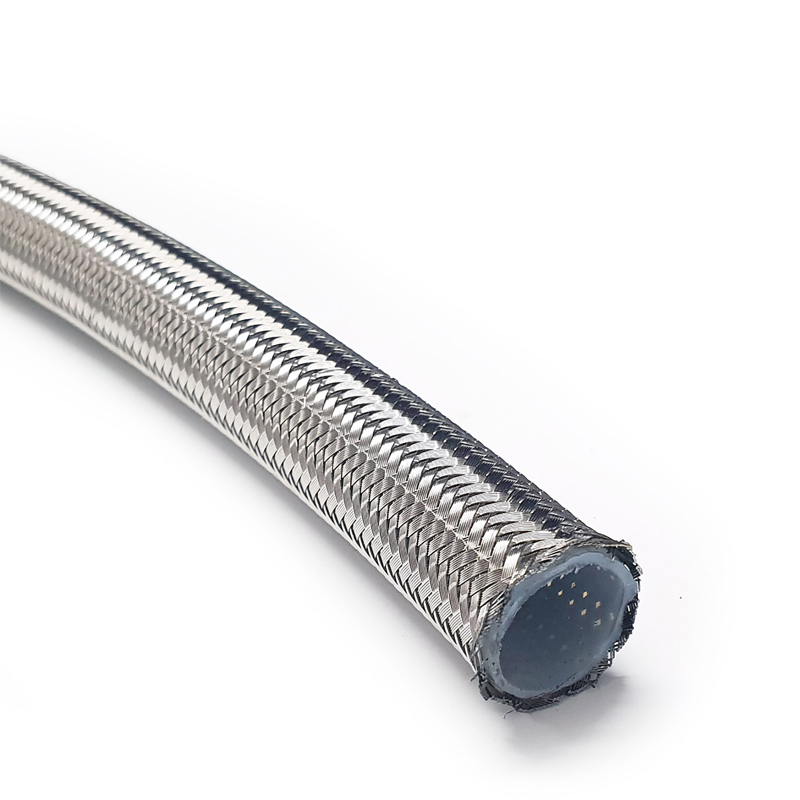
Therefore, high-pressure braided hose PTFE is a high-performance material for our modern industry. While PTFE material has many advantages, it also has some disadvantages. The advantages and disadvantages need to be fully considered when designing and selecting materials to ensure that PTFE applications can fully utilize the advantages while avoiding or compensating for shortcomings.